Taiwan Parking Facility Deploys AONPOS APK13 Self-Service Kiosk for a More Efficient Parking Experience
Aug 14, 2026Location: Taiwan
Industry: Parking & Mobility
Customer: Confidential
Product: AONPOS APK13 Self-Service Kiosk
Application: Parking Self-Service Terminal
As parking facilities become increasingly digital, operators are looking for ways to simplify customer interactions while reducing dependence on staffed service counters. For one parking-related customer in Taiwan, the goal was to introduce a reliable self-service terminal that could support its parking service workflow while providing drivers with a simple and intuitive user experience.
Because of confidentiality requirements, the customer's company name and detailed project information cannot be disclosed. However, the application represents a practical example of how the AONPOS APK13 self-service kiosk can be adapted for parking environments.
The customer selected the APK13 as the hardware platform for its parking self-service solution. With a large touchscreen, flexible computing options, integrated peripheral capability and a freestanding metal enclosure, the kiosk provides a practical foundation for parking payment, information inquiry, QR code interaction and receipt printing applications.
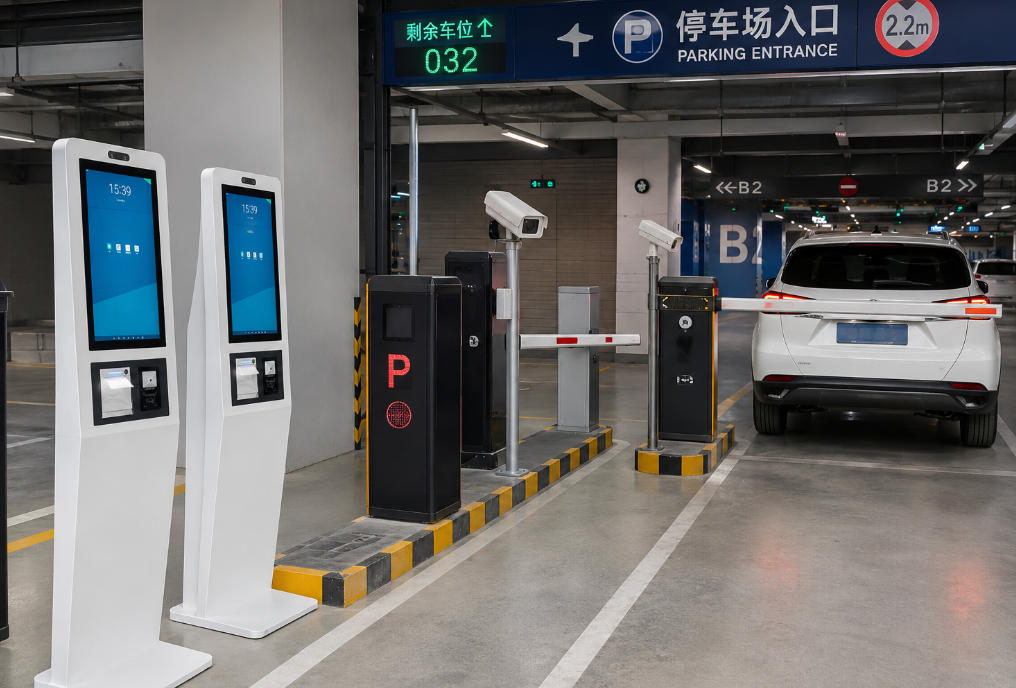
Parking environments create a different set of requirements from conventional retail POS applications.
Users typically expect parking transactions to be completed quickly. They may approach the terminal carrying bags, returning to their vehicles or simply wanting to leave the parking facility as soon as possible. A complicated interface or fragmented hardware setup can easily create queues and increase the need for staff assistance.
For the Taiwan customer, the self-service terminal therefore needed to provide a straightforward physical interface between the parking management software and the driver.
The project required a kiosk platform capable of supporting several important functions within a single enclosure:
A large and responsive touchscreen for self-service operation
QR code and barcode scanning capability for parking-related identification or transaction workflows
Receipt printing
Flexible connectivity with the customer's parking management system
Support for either Android- or Windows-based software environments
A durable freestanding structure suitable for long-term commercial deployment
Sufficient internal space and interfaces for peripheral integration
Instead of combining a monitor, scanner, printer and computer as separate devices, the customer wanted a cleaner integrated terminal that could become part of the parking facility's overall service infrastructure.
The APK13 was selected because its modular architecture allowed the hardware configuration to be adapted to the customer's application rather than forcing the parking software to conform to a fixed kiosk design.
The terminal is available with 21.5-inch and 27-inch IPS display options, both offering 1920 × 1080 Full HD resolution. The large vertical display provides sufficient space for parking instructions, transaction information, payment guidance and other user prompts.
For customer interaction, the APK13 uses projected capacitive touch technology with a G+G structure, supporting up to 10 touch points. Touch accuracy is specified at ≤2 mm with a response time of ≤6 ms, helping provide a responsive interaction experience during self-service operation.
The AG/AF-treated tempered glass surface also contributes to a cleaner commercial appearance while supporting frequent touchscreen interaction.
Another important consideration was compatibility with the customer's software environment.
APK13 can be configured with either an Android or Windows computing platform.
For Android applications, the kiosk can use an RK3568 platform with Android 11 and a quad-core ARM Cortex-A55 processor, together with Wi-Fi, RJ45 and optional 4G connectivity.
For Windows-based deployments, a Windows configuration is also available, supporting Windows 10 or Windows 11.
This flexibility is particularly useful for parking solution providers because the kiosk hardware can be integrated into different software architectures without requiring the operator to redesign the complete self-service terminal around one operating system.
Connectivity options including RJ45 Ethernet, 2.4G/5G Wi-Fi, USB and optional 4G support also provide multiple possibilities for connecting the terminal to the customer's parking management infrastructure.
For a parking self-service application, the terminal itself is only one part of the solution. Peripheral integration is equally important.
The APK13 platform supports several optional modules that can be selected according to the project requirements.
The optional 2D scanning module supports QR Code, PDF417 and DataMatrix, together with commonly used 1D barcode formats including EAN13, Code128, Code39 and Code93.
In a parking environment, this provides the hardware capability required for software workflows involving QR-based parking records, electronic parking information, validation codes or other barcode-based interactions.
The scanner supports a wide reading angle, helping users present codes naturally without requiring highly precise positioning.
APK13 can also integrate a thermal printer with printing speeds of up to 180 mm/s, a resolution of 203 dpi and a 72 mm printing width.
The printer supports both full and partial cutting.
For parking operations, an integrated printer can be used by the customer's software to provide physical transaction records or other printed information when required, without adding a separate external printer beside the kiosk.
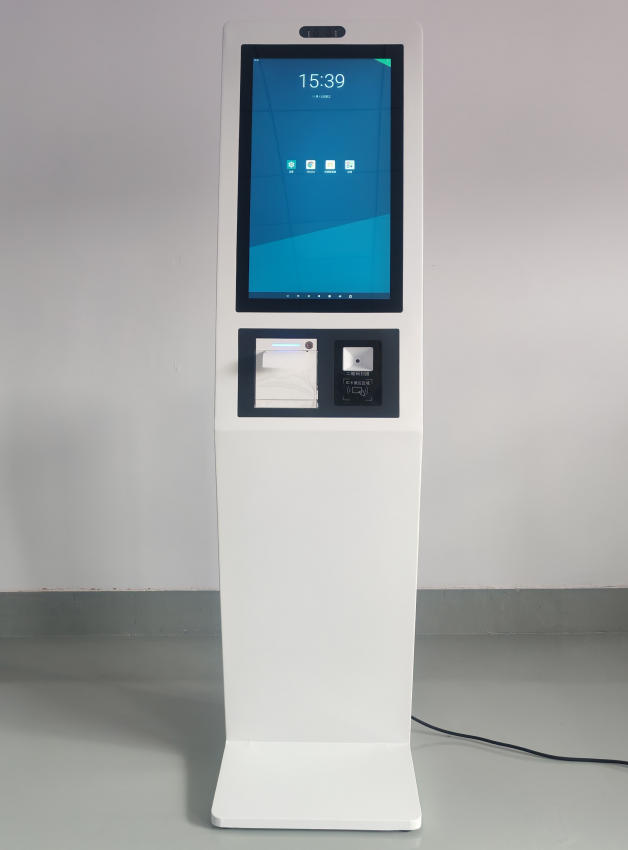
An optional contactless card reader supports Mifare One S50/S70, Mifare UltraLight and NTAG213/215/216.
This gives parking solution developers additional flexibility when designing applications involving membership cards, identification cards or other compatible contactless-card workflows.
The kiosk can additionally accommodate a camera module with up to 1920 × 1080 resolution at 30 fps.
Depending on the software design of the parking project, this provides another integration option for applications that require image-based interaction or identification functions.
The physical construction of the APK13 was also an important part of its suitability for this type of project.
Unlike a desktop POS terminal, APK13 is a full-height freestanding kiosk. Its enclosure combines a metal body with an aluminum-alloy frame and AG/AF tempered glass.
The product can be supplied in a white-and-black finish, with other colors available for customized projects.
Depending on the display size, the kiosk has a net weight of approximately 30 kg for the 21.5-inch configuration and 38 kg for the 27-inch configuration, giving the terminal a substantial freestanding structure for commercial installations.
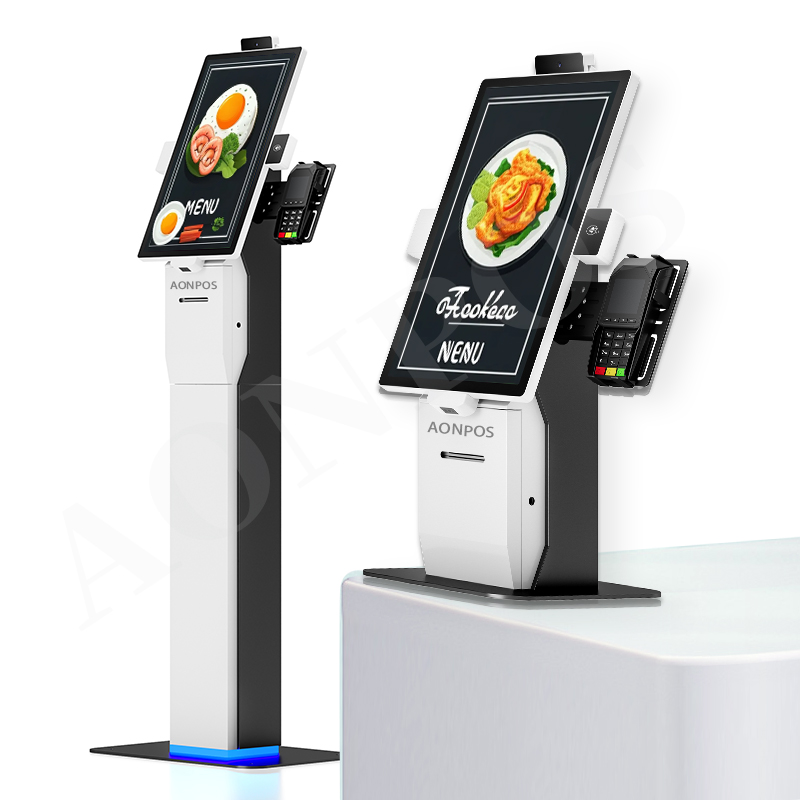
The front-facing design also allows key interaction modules to be positioned together around the display area. As shown in the APK13 product configuration, the touchscreen, printer and scanning-related modules can be integrated into one coherent terminal rather than appearing as unrelated external peripherals.
For the parking customer, this integrated approach helped provide a cleaner deployment and a more consistent customer-facing interface.
In this project, the APK13 serves as the physical self-service interface between drivers and the customer's parking system.
Instead of requiring every routine interaction to be handled by parking staff, the kiosk enables the customer's software to guide users through the required parking service process directly on the touchscreen.
Depending on the specific parking transaction, users can interact with the system through the display, scan the relevant QR code or barcode and receive printed information when required.
From an operational perspective, consolidating these functions into one terminal creates a more structured self-service point within the parking facility.
For the parking operator, the value of the kiosk is therefore not simply the touchscreen itself. The more important advantage is that display, computing, scanning, printing, connectivity and other optional peripherals can be integrated into a single hardware platform.
This gives the customer's software team a standardized terminal on which to build and operate its parking application.
Following the deployment, the APK13 became part of the customer's parking self-service infrastructure in Taiwan.
The project demonstrates how a modular commercial kiosk can support the transition from staff-dependent parking services toward a more automated customer journey.
By integrating the required interaction hardware into a single enclosure, the solution provides drivers with a clear self-service point while giving the operator a standardized hardware platform for its parking management application.
It also demonstrates an important aspect of AONPOS projects: the same self-service kiosk platform does not need to be limited to one industry.
By adjusting the operating system, peripheral modules, connectivity and software integration, APK13 can be configured for different commercial self-service scenarios, including parking facilities, ticketing, visitor management, retail service, information inquiry and other unattended applications.
For AONPOS, a successful kiosk project is not simply about supplying a screen inside a metal enclosure.
Different applications require different combinations of computing performance, connectivity, scanners, printers, card readers and structural design. Parking projects are a good example: the hardware must work as part of a larger operational system rather than as an isolated device.
The Taiwan APK13 parking project illustrates this application-oriented approach.
By combining a Full HD capacitive touchscreen, Android or Windows computing options, network connectivity and configurable peripheral modules in a freestanding commercial enclosure, AONPOS APK13 provides a flexible hardware foundation for parking self-service applications.
For parking management companies, software developers, system integrators and solution providers developing similar projects, AONPOS can configure the kiosk hardware according to the required software environment, peripherals and deployment scenario.
Looking for a customizable self-service kiosk for your parking solution? Contact AONPOS to discuss your hardware requirements and integration needs.
Tel / Whatsapp : +86 -15999943922
بريد إلكتروني : nikki@aonpostech.com


© 2026 شنتشن Aonpos التكنولوجيا المحدودة .كل الحقوق محفوظة