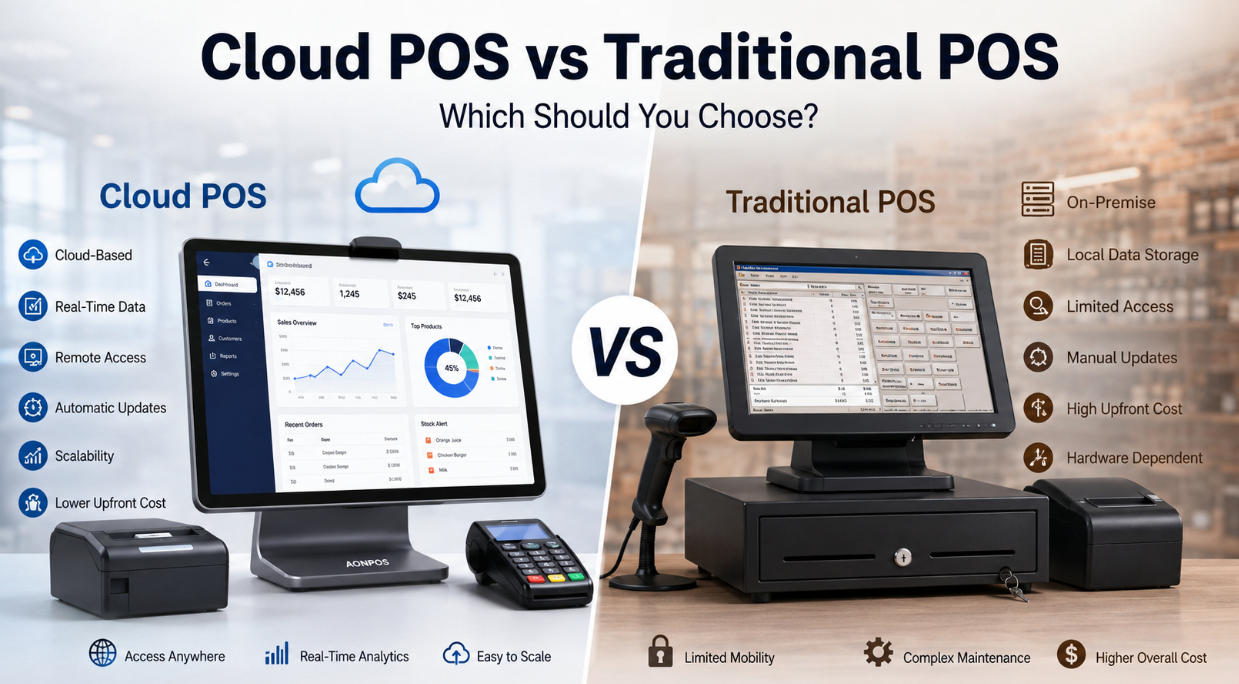
Cloud POS vs Traditional POS: Which Should You Choose?
May 25, 2026
In today’s fast-changing retail and hospitality landscape, choosing the right point-of-sale system is more important than ever. Businesses are no longer simply looking for a tool to process transactions — they need a solution that improves efficiency, supports growth, and delivers better customer experiences.
One of the biggest decisions business owners face is choosing between a cloud POS and a traditional POS system. While both solutions serve the same core purpose, they differ significantly in terms of flexibility, cost, maintenance, and scalability.
This guide explores the key differences between cloud POS vs traditional POS systems, helping retailers, restaurants, and service businesses make a smarter long-term investment.
What is a Traditional POS System?
A traditional POS (Point of Sale) system is an on-premise solution where software and data are stored locally on a business’s physical servers or terminals. These systems have been widely used for decades in retail stores, supermarkets, and restaurants.
Traditional POS setups usually include:
Desktop terminals
Receipt printers
Cash drawers
Barcode scanners
Local servers
Licensed POS software
Because everything is installed on-site, businesses are responsible for system maintenance, updates, backups, and troubleshooting.
Key Characteristics of Traditional POS
Local data storage
One-time software licensing fees
Limited remote access
Manual software updates
Hardware-dependent operations
Traditional POS systems are often preferred by businesses with stable operations and minimal need for remote management.
What is a Cloud POS System?
A cloud POS system operates through the internet, storing business data securely in the cloud rather than on local servers. Users can access the system from virtually anywhere using computers, tablets, or smartphones.
Modern cloud POS platforms provide real-time access to sales reports, inventory, customer information, and employee management tools.
Key Characteristics of Cloud POS
Cloud-based data storage
Subscription-based pricing
Remote access and management
Automatic updates
Multi-location support
Mobile device compatibility
Cloud solutions have become increasingly popular among growing retailers, restaurants, cafes, and franchise businesses due to their flexibility and scalability.
Cloud POS vs Traditional POS: Major Differences
1. Installation and Setup
Traditional POS
Traditional systems often require extensive hardware installation and on-site configuration. Initial deployment can take days or even weeks depending on the business size.
Cloud POS
Cloud POS systems are generally easier to deploy. Businesses can often set up operations quickly using tablets or existing devices with minimal technical expertise.
Winner: Cloud POS
2. Cost Structure
Traditional POS
Traditional POS systems typically involve:
High upfront hardware costs
Software licensing fees
Server maintenance expenses
IT support costs
Although long-term subscription fees are avoided, the initial investment can be substantial.
Cloud POS
Cloud-based systems usually operate on monthly or annual subscription plans. This lowers the upfront investment and makes budgeting more predictable.
Costs may include:
Subscription fees
Payment processing
Optional hardware
For small and medium-sized businesses, cloud POS systems are often more affordable initially.
Winner: Cloud POS for lower upfront cost
3. Accessibility and Remote Management
Traditional POS
Access is usually limited to the physical business location. Remote monitoring often requires additional infrastructure or VPN setups.
Cloud POS
One of the biggest advantages of cloud POS systems is remote accessibility. Business owners can monitor:
Sales performance
Inventory levels
Staff activity
Customer data
from anywhere with an internet connection.
This is especially useful for multi-store operations and mobile businesses.
Winner: Cloud POS
4. Data Security and Backup
Traditional POS
Data is stored locally, meaning businesses are fully responsible for backups and cybersecurity measures. Hardware failures can sometimes lead to data loss.
Cloud POS
Most cloud POS providers offer encrypted cloud storage, automatic backups, and security updates. Reputable vendors invest heavily in data protection infrastructure.
However, businesses should still choose providers with strong compliance standards and security certifications.
Winner: Cloud POS for automated protection
5. Internet Dependency
Traditional POS
Traditional systems can usually continue operating without internet access because everything is stored locally.
Cloud POS
Cloud POS systems rely heavily on internet connectivity. While many modern systems include offline modes, internet disruptions may temporarily limit certain functions.
Businesses in areas with unstable internet should carefully evaluate this factor.
Winner: Traditional POS
6. Scalability
Traditional POS
Expanding a traditional POS system often requires additional servers, licenses, and manual setup, which can become expensive and time-consuming.
Cloud POS
Cloud systems are designed for scalability. Adding new terminals, stores, or users is generally fast and straightforward.
This flexibility makes cloud POS ideal for growing businesses and franchises.
Winner: Cloud POS
7. Software Updates and Maintenance
Traditional POS
Updates may require manual installation, IT support, or even downtime during upgrades.
Cloud POS
Cloud POS providers usually deliver automatic software updates, ensuring businesses always have access to the latest features and security improvements.
Winner: Cloud POS
Advantages of Cloud POS Systems
Businesses increasingly prefer cloud POS systems because they offer:
Real-time analytics
Easier multi-location management
Lower upfront costs
Flexible hardware compatibility
Faster deployment
Automatic updates
Better mobility
Cloud POS solutions are especially attractive for:
Retail chains
Restaurants
Cafes
Pop-up stores
Service businesses
Mobile vendors
Advantages of Traditional POS Systems
Despite the shift toward cloud technology, traditional POS systems still have strengths.
Benefits include:
Offline reliability
Full local control over data
Lower recurring subscription costs
Stable long-term operations
Less dependence on internet connectivity
Traditional POS may still suit businesses that:
Operate in low-connectivity areas
Prefer on-premise infrastructure
Have established legacy systems
Require customized local configurations
Which Businesses Should Choose Cloud POS?
Cloud POS systems are generally ideal for businesses that prioritize flexibility and growth.
Best fit for:
Small and medium-sized retailers
Restaurants and cafes
Franchise operations
Businesses with multiple locations
Companies needing remote access
Fast-growing brands
Many modern POS providers, including companies like Aonpos, are focusing on cloud-enabled POS solutions designed to help businesses streamline operations while adapting to changing consumer expectations.
Which Businesses Should Choose Traditional POS?
Traditional POS systems may still work well for businesses that require:
Complete local infrastructure control
Offline-first operations
Minimal software changes
Highly customized setups
Industries with strict internal IT policies sometimes continue using traditional systems for operational consistency.
Final Thoughts: Cloud POS vs Traditional POS
The decision between cloud POS vs traditional POS ultimately depends on your business needs, budget, growth plans, and operational priorities.
If your business values mobility, scalability, remote access, and easier management, a cloud POS system is often the smarter long-term choice.
On the other hand, if internet reliability is a concern or your business depends heavily on localized infrastructure, a traditional POS system may still provide advantages.
As digital transformation continues reshaping retail and hospitality industries, cloud-based POS technology is becoming the preferred solution for businesses seeking efficiency, flexibility, and future-ready operations.
Choosing the right POS system today can significantly impact your operational success tomorrow.