Pharmacy POS Hardware Buying Guide: How to Build a Reliable Pharmacy Checkout System
Jul 15, 2026
A pharmacy requires more than a standard cash register. In addition to processing everyday retail transactions, a pharmacy checkout station may need to handle prescription pickups, over-the-counter products, membership programs, insurance-related workflows, barcode-based inventory, customer identification, and multiple payment methods.
The right pharmacy POS hardware provides a stable foundation for these operations. It helps pharmacists and cashiers complete transactions efficiently, reduces scanning and data-entry errors, and supports the pharmacy’s software, inventory, and customer-service processes.
However, pharmacy owners, system integrators, software companies, and equipment distributors must evaluate more than screen size or processor specifications. Hardware reliability, peripheral compatibility, hygiene, serviceability, and long-term availability can all affect the total value of a pharmacy POS deployment.
This pharmacy POS hardware buying guide explains the essential components, specifications, and purchasing considerations for independent pharmacies, hospital pharmacies, health and beauty retailers, and multi-location pharmacy chains.
What Is a Pharmacy POS System?
A pharmacy POS system is the combination of hardware and software used to manage checkout transactions and related retail workflows in a pharmacy.
Depending on the pharmacy’s operating model, the system may support:
Prescription pickup transactions
Over-the-counter medicine sales
Health, beauty, and personal-care product sales
Barcode scanning
Inventory updates
Customer or loyalty accounts
Staff permissions
Discounts and promotions
Receipt printing
Cash and electronic payments
Sales reporting
Multi-store management
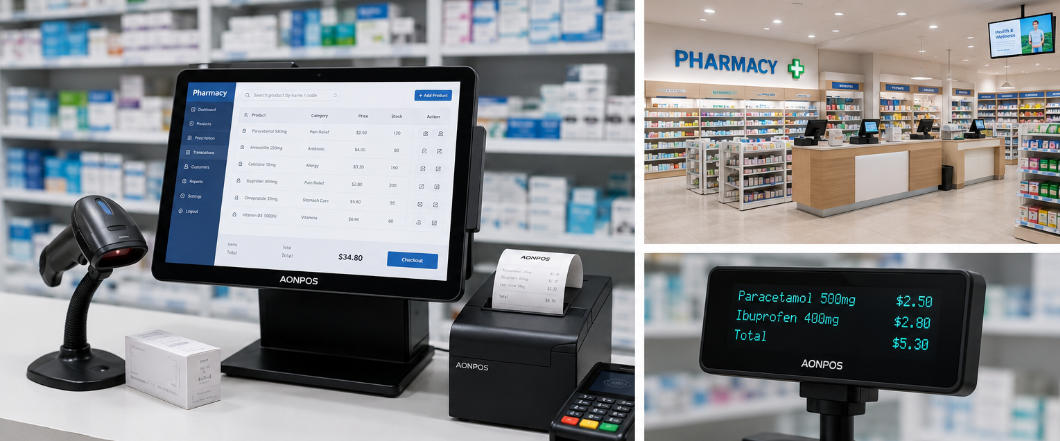
The POS terminal acts as the primary workstation, while scanners, printers, cash drawers, customer displays, payment devices, and other peripherals complete the checkout configuration.
Because pharmacy software requirements vary by country, region, and business model, buyers should confirm software compatibility before selecting the hardware platform.
Why Pharmacy POS Hardware Requires Careful Selection
Pharmacies combine the workflows of healthcare service environments and retail stores. This creates several hardware requirements that may not be as important in a small general merchandise shop.
Transaction Accuracy
A pharmacy may sell products with similar names, packaging, strengths, or sizes. Reliable barcode scanning and a responsive POS interface help reduce manual selection errors at checkout.
Continuous Daily Operation
Many pharmacies operate long hours, including weekends and holidays. Hardware instability can interrupt prescription pickup, delay customers, and create additional work for staff.
Commercial-grade POS hardware is generally a better choice than consumer computers that were not designed for continuous transaction environments.
Limited Counter Space
Pharmacy counters often contain prescription bags, paperwork, card terminals, scanners, printers, and customer-facing materials. A compact all-in-one POS terminal helps preserve workspace while keeping essential devices accessible.
Hygiene and Cleaning
Pharmacy equipment is frequently touched by employees and may be located near customer service areas. Smooth surfaces, minimal screen bezels, stable housings, and manageable cable layouts can make routine cleaning easier.
Peripheral Integration
A pharmacy checkout station may require more connected devices than a basic retail counter. Buyers should confirm that the terminal has enough USB, serial, network, display, and cash-drawer connections for the complete setup.
Essential Pharmacy POS Hardware Components
A complete pharmacy POS setup normally includes several coordinated devices.
1. All-in-One Touchscreen POS Terminal
The terminal is the central component of the pharmacy POS system. It runs the POS application and connects to the pharmacy’s checkout peripherals.
An all-in-one terminal integrates the computer and touchscreen into a single commercial enclosure. Compared with a separate desktop computer and monitor, this design can reduce counter clutter, simplify installation, and create a more professional checkout area.
Buyers can explore the AONPOS POS system range for all-in-one touchscreen terminals designed for retail and other commercial applications.
Recommended Terminal Features
For most pharmacy counters, consider:
A 15-inch or 15.6-inch capacitive touchscreen
An Intel or ARM processor compatible with the selected software
At least 4 GB of memory for basic applications
8 GB or more for demanding or multi-application environments
SSD or eMMC storage
Gigabit Ethernet
Wi-Fi where wireless networking is required
Multiple USB ports
Serial ports for legacy peripherals when necessary
A compact and stable stand
Windows or Android support based on the software platform
The final specification should be based on the software vendor’s requirements rather than choosing the highest configuration automatically.
2. Barcode Scanner
Barcode scanning is essential in most pharmacies. It allows staff to identify products quickly and helps ensure that the correct item, package size, and price are selected.
A 2D barcode scanner is usually more flexible than a basic 1D scanner because it can read:
Standard retail barcodes
QR codes
Data Matrix codes
Barcodes displayed on smartphones
Membership or loyalty codes
Promotional vouchers
Scanner selection should also consider damaged-label performance, reading distance, scanning angle, and compatibility with small or curved medicine packages.
For counters with frequent transactions, a presentation scanner can provide hands-free operation. A handheld scanner may be more suitable when employees need to scan large packages or products away from the main counter position.
3. Receipt Printer
A thermal receipt printer creates transaction records for customers and may also print pickup references, order numbers, coupons, or return documentation.
Common printer widths include 58 mm and 80 mm. An 80 mm printer typically provides more space for detailed receipts, branding, product descriptions, tax information, and return policies.
Important printer considerations include:
Print speed
Cutter reliability
Paper-loading design
Driver compatibility
USB, Ethernet, Bluetooth, or serial connectivity
Local paper availability
Ease of maintenance
A pharmacy with several checkout stations may benefit from Ethernet-connected printers because they can be managed more flexibly across the store network.
4. Cash Drawer
Although electronic payments continue to grow, many pharmacies still accept cash. A commercial cash drawer should provide sufficient compartments, a secure locking mechanism, and compatibility with the receipt printer or POS terminal.
Before purchasing, confirm:
Drawer dimensions
Currency layout
Number of bill and coin compartments
Printer-driven or terminal-driven connection
Manual key access
Expected transaction volume
Counter installation requirements
For high-volume locations, steel construction and durable drawer slides can provide better long-term reliability.
5. Payment Terminal
The payment terminal may support credit cards, debit cards, chip cards, contactless cards, and mobile wallets. Payment hardware is often supplied or approved by a payment processor, acquiring bank, or local payment service provider.
The POS terminal and payment device may operate independently or through an integrated connection.
Before deployment, buyers should confirm:
Payment processor compatibility
Supported payment methods
Integration with the pharmacy POS software
Regional certification requirements
Cable or wireless connection options
Countertop mounting requirements
Responsibility for software and security updates
AONPOS primarily focuses on POS hardware platforms and checkout peripherals. Payment processing approval should be confirmed separately with the relevant payment provider.
6. Customer-Facing Display
A customer display shows transaction information such as scanned products, quantities, prices, discounts, taxes, and the final amount.
For pharmacies, this can improve checkout transparency and allow customers to identify pricing issues before payment.
A larger second screen may also display:
Loyalty enrollment information
Store promotions
Health and wellness campaigns
Seasonal product recommendations
Digital receipts
Customer-facing payment instructions
A dual-screen configuration can be particularly useful in pharmacies that also operate as health, beauty, or convenience retailers.
7. Label or Document Printer
Some pharmacy workflows require additional printing beyond standard sales receipts. Depending on local regulations and software functions, the pharmacy may need separate devices for product labels, shelf labels, pickup documentation, or internal stock records.
These printers should be evaluated separately from the receipt printer because print size, media type, resolution, and software integration requirements can differ.
8. UPS and Power Protection
Unexpected power interruptions can stop checkout operations and potentially affect locally stored transaction data.
A suitable uninterruptible power supply can provide temporary power for the POS terminal, network equipment, and selected peripherals. Surge protection is also important in areas with unstable electricity.
When choosing a UPS, calculate the combined power requirements of all connected equipment rather than sizing it for the POS terminal alone.
Key Features to Look for in Pharmacy POS Hardware
Reliable Commercial-Grade Construction
A pharmacy POS terminal should be designed for repeated daily use. Look for:
Durable touchscreen glass
A stable metal or reinforced stand
Secure hinges
Commercial-grade connectors
Effective thermal management
Easy access for maintenance
Replaceable storage or memory where required
Fanless terminals can reduce noise and limit the amount of dust drawn into the enclosure. However, the terminal must still provide effective heat dissipation for the selected processor and operating environment.
Responsive Capacitive Touchscreen
Employees may perform hundreds of touchscreen actions during a shift. A slow or inaccurate screen can affect productivity and increase frustration.
Projected capacitive touchscreens generally provide smooth operation and support multi-touch gestures. A true-flat or narrow-bezel design can also be easier to clean than a deeply recessed display.
For most pharmacy counters, a 15-inch or 15.6-inch screen provides a practical balance between visibility and counter space.
Adequate Processor and Memory
The required performance depends on the pharmacy software, operating system, browser usage, database architecture, connected devices, and number of applications running at the same time.
A basic pharmacy retail application may operate well on an entry-level processor. More complex environments involving multiple software modules, local databases, video content, or background integrations may require a higher-performance configuration.
When comparing specifications, evaluate:
Processor generation and architecture
Number of cores
Memory capacity
Storage type
Operating-system requirements
Software vendor recommendations
Expected software lifecycle
The article on key factors in POS hardware selection provides additional guidance on evaluating processors, memory, storage, displays, and connectivity.
SSD Storage
Solid-state drives generally provide faster startup, quieter operation, and better resistance to vibration than mechanical hard drives.
Storage capacity should account for:
Operating-system files
Pharmacy or retail software
Local databases
Product images
Log files
Updates
Temporary files
Future software growth
Even when most data is stored in the cloud, sufficient local storage is necessary for reliable system operation.
Sufficient Connectivity
A pharmacy POS station may need to connect to a scanner, receipt printer, cash drawer, payment terminal, customer display, keyboard, scale, label printer, network, and other devices.
Prepare a complete peripheral list before ordering the terminal.
Common connections include:
USB-A
USB-C
RS-232 serial
RJ45 Ethernet
HDMI or VGA
Audio
Wi-Fi
Bluetooth
Cash-drawer ports
Powered USB in specialized installations
It is advisable to leave one or two ports available for future expansion or service equipment.
Network Reliability
Pharmacies may depend on cloud-hosted systems, central databases, real-time inventory, electronic payments, and multi-location reporting. Stable network connectivity is therefore essential.
A wired Ethernet connection is generally preferred for the primary checkout station because it offers predictable performance. Wi-Fi can provide flexibility but should be supported by secure, business-grade network infrastructure.
Where continuous service is critical, buyers may also consider:
Backup internet connectivity
Local offline transaction support
Redundant network equipment
Automatic data synchronization
Remote device monitoring
Offline capabilities depend mainly on the POS software and payment environment, so they should be verified before deployment.
Software and Operating-System Compatibility
Hardware should be selected around the intended pharmacy software.
Before placing an order, confirm:
Supported operating systems
Minimum and recommended processor requirements
Memory requirements
Display resolution
Touchscreen driver support
Peripheral driver availability
Browser requirements
Database requirements
Payment integration
Local language support
Windows is widely used for desktop pharmacy applications and legacy peripheral integration. Android may be suitable for cloud-based, lightweight, or purpose-built retail applications.
Neither platform is automatically better. The correct choice depends on the pharmacy software and IT environment.
Security Considerations
Pharmacy POS hardware can contribute to system security, but security also depends heavily on software, network architecture, staff procedures, and regulatory requirements.
A secure deployment may include:
Individual employee accounts
Role-based access permissions
Automatic screen locking
Encrypted network communication
Regular software updates
Antivirus or endpoint protection where appropriate
Restricted USB access
Secure device mounting
Controlled administrator privileges
Reliable backup procedures
The POS terminal should not be treated as the sole storage location for critical business information.
Pharmacies should work with qualified software, payment, and compliance providers to determine the requirements applicable to their country and operating model.
Single-Screen or Dual-Screen Pharmacy POS?
Both configurations can work effectively, depending on the pharmacy’s priorities.
Single-Screen POS
A single-screen terminal is suitable for:
Small independent pharmacies
Limited counter space
Low to moderate transaction volumes
Budget-sensitive deployments
Counters where a separate customer display is already installed
It is usually simpler to deploy and requires less space.
Dual-Screen POS
A dual-screen terminal may be suitable for:
High-volume pharmacy counters
Health and beauty retail formats
Pharmacies with loyalty programs
Locations displaying promotions
Stores requiring greater checkout transparency
Modern customer-facing counter designs
The second screen can show transaction details, promotional content, or customer instructions without interrupting the cashier interface.
Recommended Pharmacy POS Configurations
Different pharmacy formats may require different hardware combinations.
Independent Community Pharmacy
A practical setup may include:
15-inch all-in-one touchscreen POS
Entry-level or mid-range processor
4 GB to 8 GB memory
SSD storage
2D handheld barcode scanner
80 mm thermal receipt printer
Cash drawer
Payment terminal
Wired Ethernet
UPS
This configuration offers a balance of cost, reliability, and functionality.
High-Volume Pharmacy
A higher-volume location may require:
15.6-inch commercial POS terminal
Mid-range or high-performance processor
8 GB or more memory
SSD storage
Presentation barcode scanner
Customer-facing display
High-speed 80 mm printer
Heavy-duty cash drawer
Integrated payment terminal
Gigabit Ethernet
Backup connectivity
UPS and surge protection
The focus should be transaction speed, ergonomic operation, and reduced downtime.
Pharmacy and Health Retail Store
A combined pharmacy and retail store may benefit from:
Dual-screen POS terminal
2D presentation scanner
Customer-facing promotional display
Receipt printer
Cash drawer
Payment terminal
Loyalty or membership reader
Label printer
Inventory handheld device
Multi-location management support
This configuration supports both pharmacy service and broader retail merchandising.
Multi-Store Pharmacy Chain
A pharmacy chain should prioritize standardization.
The hardware specification may include:
A consistent terminal model across locations
Standard processor, memory, and storage configuration
Identical scanner and printer models
Centralized operating-system images
Asset identification labels
Remote management tools
Spare equipment strategy
Standard mounting and cable plans
Long-term component availability
Standardization makes training, maintenance, replacement, and software testing more efficient.
Retail buyers planning larger rollouts may also find the grocery store POS hardware buying guide useful, as many high-volume grocery checkout considerations also apply to pharmacy retail environments.
Questions to Ask Before Buying Pharmacy POS Hardware
Before requesting a quotation, prepare clear answers to the following questions.
What Software Will Run on the Terminal?
Provide the operating system, software name, minimum hardware specification, and required drivers.
Which Peripherals Must Be Connected?
List every scanner, printer, cash drawer, display, payment device, keyboard, scale, label printer, and external accessory.
How Many Checkout Stations Are Required?
Include initial quantities, pilot units, spare units, and expected future expansion.
What Is the Daily Transaction Volume?
Transaction volume influences the appropriate printer, scanner, cash drawer, and terminal specification.
Is a Customer Display Required?
Determine whether the store needs a basic price display or a full second touchscreen.
What Network Connections Are Available?
Confirm whether the site will use Ethernet, Wi-Fi, Bluetooth, mobile data, or a combination.
Are Customizations Needed?
OEM and ODM buyers may require:
Custom logos
Housing colors
Packaging
BIOS settings
Operating-system installation
Memory and storage configurations
Port changes
Branded startup screens
Custom stands
Peripheral bundles
Regional power adapters
What Certifications Are Required?
Certification requirements vary by country and project. Confirm electrical, environmental, radio, payment, and import requirements before mass production.
What Is the Warranty and Support Process?
Clarify:
Warranty period
Covered components
Response times
Spare-part availability
Remote technical support
Repair procedures
Replacement policy
Shipping responsibilities
Product lifecycle
The guide on choosing a Chinese POS hardware supplier discusses supplier evaluation, after-sales support, and total-cost considerations in greater detail.
Common Pharmacy POS Buying Mistakes
Choosing Hardware Before Confirming the Software
A terminal may appear powerful but still be unsuitable if the software requires a different operating system, screen resolution, port type, or processor architecture.
Always confirm software requirements first.
Comparing Only the Initial Purchase Price
Low-cost equipment can become expensive if it produces frequent failures, lacks compatible drivers, or cannot be repaired locally.
Evaluate the total cost of ownership, including:
Installation
Software setup
Peripheral replacement
Maintenance
Staff downtime
Spare units
Technical support
Shipping
Future upgrades
Ordering Too Few Ports
A terminal with enough ports for the initial setup may have no capacity for a future scanner, display, printer, or service device.
Create a port map before approving the hardware specification.
Using Consumer Devices for Permanent Checkout Stations
Consumer tablets and desktop computers can be useful in some mobile or temporary applications, but they may not provide the mounting stability, port selection, thermal performance, or lifecycle required for permanent pharmacy checkout counters.
Ignoring Ergonomics
Poor screen height, an unstable stand, inconvenient scanner placement, or excessive cable clutter can slow down employees throughout every shift.
Test the complete counter layout, not only the individual terminal.
Skipping a Pilot Deployment
For multi-location projects, a pilot installation can reveal software, driver, networking, cable, mounting, and employee-training issues before mass rollout.
A pilot should reproduce the real operating environment as closely as possible.
How to Evaluate a Pharmacy POS Hardware Supplier
A reliable supplier should do more than provide a product catalog.
Look for a partner that can support:
Hardware configuration recommendations
Software compatibility checks
Peripheral testing
OEM and ODM customization
Sample production
Pre-shipment inspection
Packaging design
International logistics
Technical documentation
Spare parts
After-sales service
Long-term project planning
Buyers should provide a clear request for quotation that includes expected quantities, operating system, processor, memory, storage, display requirements, ports, peripherals, certifications, packaging, destination country, and customization needs.
This allows suppliers to recommend a realistic configuration instead of quoting an unsuitable standard model.
Why Consider AONPOS for Pharmacy POS Projects?
AONPOS develops and manufactures all-in-one touch POS terminals and related checkout hardware for retail and commercial environments.
For pharmacy POS projects, AONPOS can support configurations involving:
Single-screen POS terminals
Dual-screen POS terminals
Windows-based hardware
Android-based hardware
Capacitive touchscreens
Multiple processor options
Configurable memory and storage
Barcode scanners
Thermal receipt printers
Touch monitors
POS stands
Other checkout peripherals
OEM and ODM customization
AONPOS hardware can be configured for independent stores, equipment distributors, software providers, system integrators, and multi-location retail projects.
Because pharmacy workflows and regulations differ across markets, AONPOS buyers should provide detailed software, peripheral, certification, and deployment requirements during the quotation process.
Final Pharmacy POS Hardware Checklist
Before purchasing a pharmacy POS system, verify the following:
The hardware is compatible with the pharmacy software.
The operating system is correctly specified.
The processor and memory meet recommended requirements.
SSD or suitable solid-state storage is included.
The touchscreen is responsive and easy to clean.
The terminal has enough ports for all peripherals.
The barcode scanner can read required 1D and 2D codes.
The receipt printer supports the correct paper width.
The cash drawer matches the local currency.
The payment terminal is approved by the payment provider.
Network and offline requirements are understood.
Power protection is included where necessary.
Warranty and support terms are documented.
Spare units and spare parts are planned.
Required certifications are confirmed.
OEM or ODM customization details are approved before production.
A pilot test is completed before a large rollout.
Conclusion
Choosing the right pharmacy POS hardware is not simply a matter of purchasing a touchscreen cash register. The complete system must support the pharmacy’s software, products, transaction volume, peripherals, network environment, payment methods, and long-term operating requirements.
For most pharmacies, a reliable all-in-one touchscreen terminal, 2D barcode scanner, thermal receipt printer, cash drawer, payment terminal, wired network connection, and power protection provide a strong starting point.
Independent pharmacies may prioritize simplicity and space efficiency, while high-volume stores and pharmacy chains may require dual screens, standardized configurations, remote management, spare-unit planning, and stronger supplier support.
By defining technical requirements before requesting quotations and testing the complete setup through a pilot deployment, buyers can reduce integration problems, control long-term costs, and build a more reliable pharmacy checkout environment.
For customizable pharmacy POS terminals and peripheral configurations, visit AONPOS to discuss your software platform, project quantity, target market, and OEM or ODM requirements.