Traditional Cash Registers vs Modern POS Systems: ROI Comparison for Retailers
Jun 23, 2026
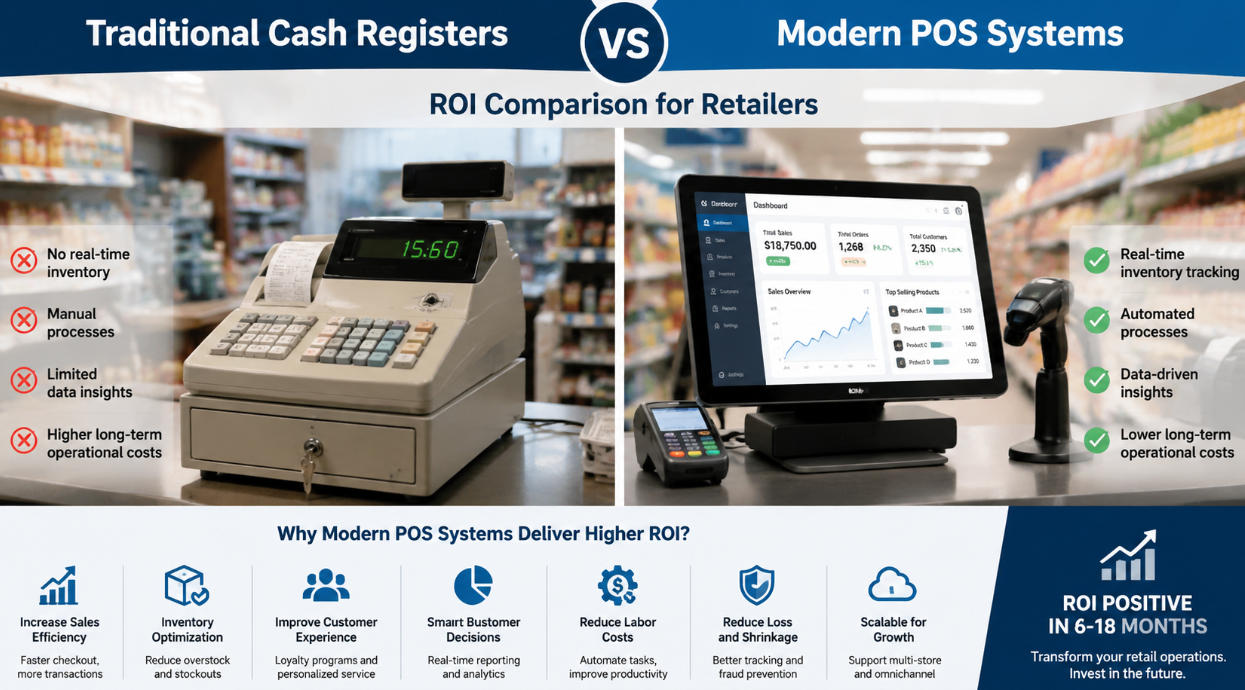
In today’s highly competitive retail environment, technology plays a decisive role in operational efficiency, customer experience, and long-term profitability. One of the most significant upgrades retailers consider is moving from traditional cash registers to modern POS systems. While the upfront investment can seem substantial, the return on investment (ROI) of a retail POS system often far outweighs its cost when evaluated over time.
This article provides a professional ROI comparison between cash registers and POS systems, focusing on cost structure, operational efficiency, and long-term business impact.
1. Cash Register vs POS System: Core Differences
A traditional cash register is designed primarily for basic transaction processing—calculating totals, storing cash, and printing receipts. It is simple, reliable, and inexpensive, but limited in functionality.
In contrast, a modern POS system is a fully integrated retail management solution. It combines sales processing with inventory tracking, analytics, customer management, and often cloud-based reporting.
Key distinction:
Cash register = transaction recording tool
POS system = retail automation system with data-driven decision support
2. Cost Structure: Initial Investment vs Long-Term Value
Traditional Cash Registers
Low upfront cost
Minimal maintenance expenses
No subscription fees
Limited upgrade capability
However, hidden costs emerge over time:
Manual inventory management labor
Higher error rates in accounting
Lost sales due to stock inaccuracies
Modern POS Systems
Higher initial setup cost
Possible subscription or licensing fees
Hardware + software integration costs
But they reduce long-term operational expenses:
Automated inventory tracking
Reduced labor dependency
Real-time sales insights
Lower shrinkage and human error
This shift transforms POS from an expense into a revenue optimization tool.
3. Retail POS ROI: Where the Value Comes From
The ROI of a retail POS system is driven by measurable improvements in efficiency and revenue generation:
1. Inventory Optimization
Modern POS systems provide real-time inventory data, reducing overstocking and stockouts. This alone can significantly improve cash flow and reduce waste.
2. Faster Checkout Experience
Reduced transaction time increases customer throughput, especially important in high-volume environments like supermarkets.
3. Data-Driven Decisions
Retailers gain insights into:
Best-selling products
Peak sales hours
Customer behavior patterns
These insights enable smarter purchasing and marketing strategies.
4. Labor Efficiency
Automation reduces reliance on manual processes such as stock counting and sales reporting, lowering operational labor costs.
4. Supermarket POS Comparison: Scale Matters
In a supermarket environment, the difference between cash registers and POS systems becomes even more pronounced.
Cash Register Limitations:
No centralized inventory system
Manual price updates
Inefficient multi-cashier coordination
POS System Advantages:
Centralized database across all checkout points
Integrated barcode scanning and pricing updates
Multi-store synchronization
Advanced loss prevention tools
For supermarkets, even a small percentage improvement in efficiency translates into substantial financial gains.
5. Modern POS Benefits Beyond Transactions
A modern POS system is no longer just a checkout tool—it is a complete retail automation system.
Additional benefits include:
Customer loyalty program integration
Cloud-based reporting and remote management
Integration with e-commerce platforms
Automated tax and compliance reporting
Multi-location business management
These capabilities significantly increase scalability and reduce administrative burden.
6. POS Upgrade Cost Analysis: Is It Worth It?
When evaluating POS upgrade cost analysis, retailers should consider:
Short-term costs:
Hardware purchase (terminals, scanners, printers)
Software subscription or licensing
Employee training
Long-term ROI factors:
Reduced inventory loss (shrinkage reduction)
Increased sales efficiency
Lower staffing requirements per transaction
Improved customer retention
In most retail scenarios, ROI becomes positive within 6–18 months depending on store size and transaction volume.
7. Final Verdict: Which One Wins?
While cash registers remain suitable for extremely small or low-transaction businesses, they are increasingly outdated in modern retail environments.
Modern POS systems clearly outperform traditional cash registers in:
Efficiency
Scalability
Data intelligence
Long-term profitability
For most retailers, upgrading to a POS system is not just a technological improvement—it is a strategic investment in business growth.