Traditional Cash Registers vs Modern POS Systems: ROI Comparison for Retailers
Jun 23, 2026In today’s highly competitive retail environment, technology plays a decisive role in operational efficiency, customer experience, and long-term profitability. One of the most significant upgrades retailers consider is moving from traditional cash registers to modern POS systems. While the upfront investment can seem substantial, the return on investment (ROI) of a retail POS system often far outweighs its cost when evaluated over time.
This article provides a professional ROI comparison between cash registers and POS systems, focusing on cost structure, operational efficiency, and long-term business impact.
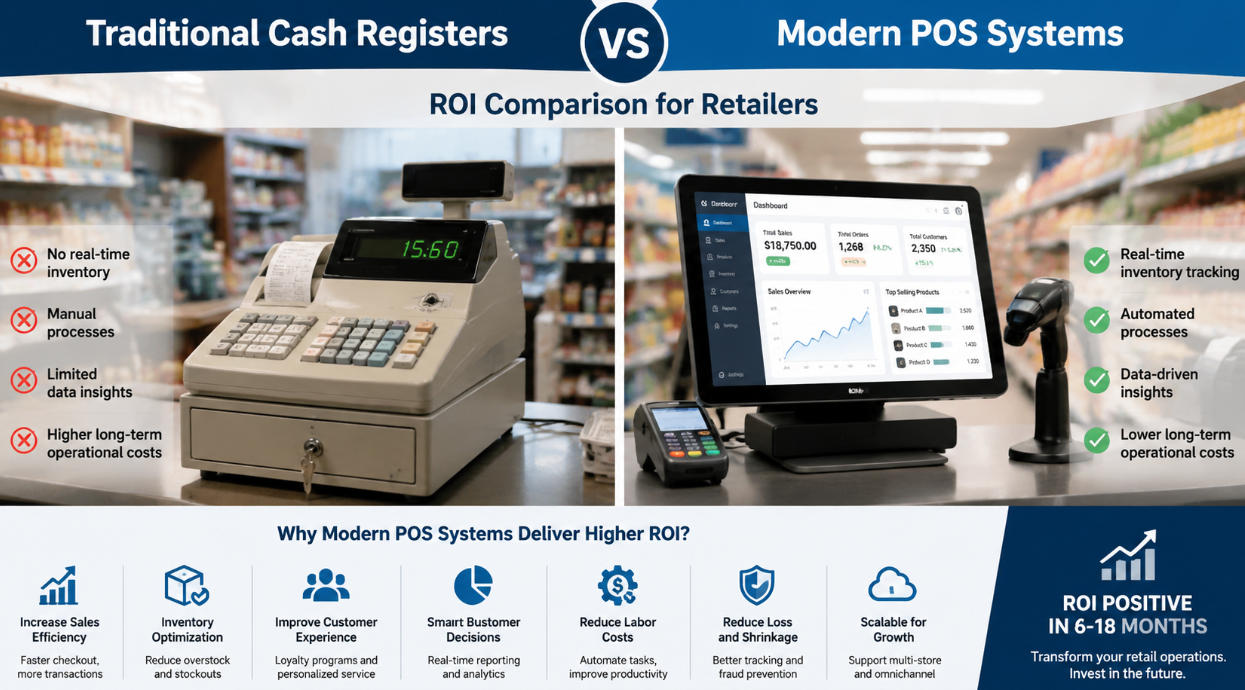
A traditional cash register is designed primarily for basic transaction processing—calculating totals, storing cash, and printing receipts. It is simple, reliable, and inexpensive, but limited in functionality.
In contrast, a modern POS system is a fully integrated retail management solution. It combines sales processing with inventory tracking, analytics, customer management, and often cloud-based reporting.
However, hidden costs emerge over time:
But they reduce long-term operational expenses:
This shift transforms POS from an expense into a revenue optimization tool.
The ROI of a retail POS system is driven by measurable improvements in efficiency and revenue generation:
Modern POS systems provide real-time inventory data, reducing overstocking and stockouts. This alone can significantly improve cash flow and reduce waste.
Reduced transaction time increases customer throughput, especially important in high-volume environments like supermarkets.
Retailers gain insights into:
These insights enable smarter purchasing and marketing strategies.
Automation reduces reliance on manual processes such as stock counting and sales reporting, lowering operational labor costs.
In a supermarket environment, the difference between cash registers and POS systems becomes even more pronounced.
For supermarkets, even a small percentage improvement in efficiency translates into substantial financial gains.
A modern POS system is no longer just a checkout tool—it is a complete retail automation system.
These capabilities significantly increase scalability and reduce administrative burden.
When evaluating POS upgrade cost analysis, retailers should consider:
In most retail scenarios, ROI becomes positive within 6–18 months depending on store size and transaction volume.
While cash registers remain suitable for extremely small or low-transaction businesses, they are increasingly outdated in modern retail environments.
Modern POS systems clearly outperform traditional cash registers in:
For most retailers, upgrading to a POS system is not just a technological improvement—it is a strategic investment in business growth.
Tel / Whatsapp : +86 -15999943922
بريد إلكتروني : nikki@aonpostech.com


© 2026 شنتشن Aonpos التكنولوجيا المحدودة .كل الحقوق محفوظة