POS Machine vs POS System: What’s the Difference?
May 28, 2026In today’s retail and hospitality industry, businesses rely heavily on digital payment and management technologies to improve efficiency, customer experience, and operational control. However, many people still confuse the terms POS machine and POS system. Although they are closely related, they are not the same thing.
Understanding the difference between a POS machine and a POS system can help business owners choose the right solution for their operations. In this article, we’ll explain how they differ, how they work together, and which one is best for your business.
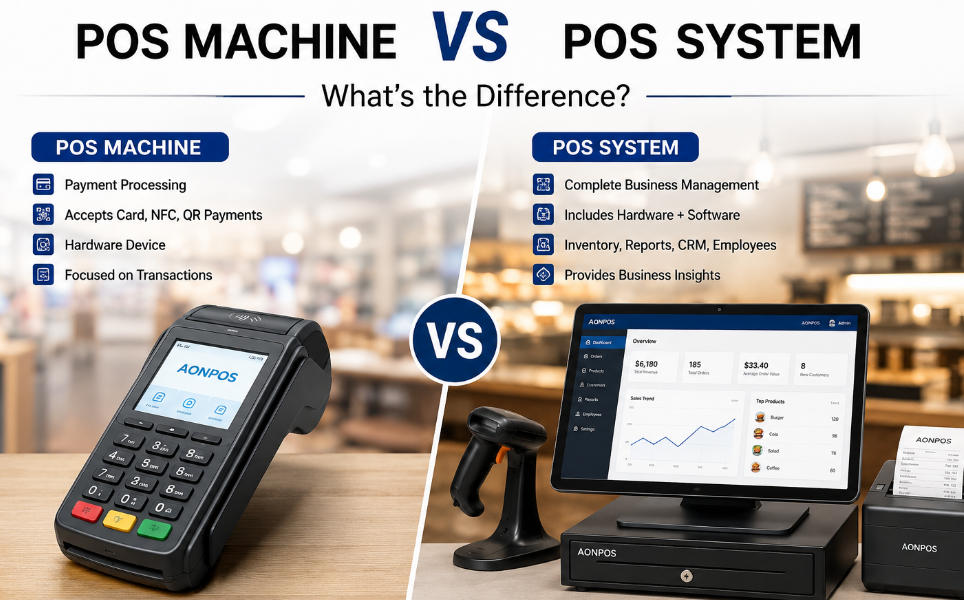
A POS machine (Point of Sale machine) is the physical device used to process transactions. It is mainly designed for accepting payments from customers through various payment methods such as:
Traditionally, POS machines were simple card terminals connected to banks or payment processors. Modern POS machines have become more advanced and often include:
In short, the POS machine focuses primarily on payment processing.
Typically used in retail stores, supermarkets, and restaurants where the terminal remains fixed at the checkout counter.
Portable devices designed for delivery services, pop-up stores, food trucks, and field businesses.
All-in-one Android POS devices that combine payment acceptance with basic business applications.
Manufacturers such as Aonpos have introduced smart POS hardware solutions that support multiple payment methods while offering greater flexibility for modern businesses.
A POS system is a complete business management solution that includes both hardware and software. While the POS machine handles payments, the POS system manages the entire transaction workflow and business operations.
A typical POS system may include:
Essentially, the POS system acts as the operational center of a business.
Understanding the distinction between the two is important when selecting technology for your business.
| Feature | POS Machine | POS System |
|---|---|---|
| Main Purpose | Payment processing | Business management |
| Components | Hardware terminal | Hardware + software |
| Functionality | Accepts payments | Manages sales, inventory, reports, and customers |
| Software Integration | Limited | Extensive |
| Business Insights | Minimal | Advanced analytics and reporting |
| Scalability | Basic | Highly scalable |
| Best For | Simple payment needs | Growing businesses with operational requirements |
A POS machine is often one component of a larger POS system. For example, when a customer makes a purchase:
This integration allows businesses to streamline operations and reduce manual work.
The answer depends on your business size, industry, and operational complexity.
Examples include:
Examples include:
Modern cloud-based POS systems offer much more than payment processing. Key benefits include:
Business owners can monitor sales, inventory, and performance remotely.
Faster checkout and multiple payment options improve customer satisfaction.
Automatic stock updates help reduce errors and prevent shortages.
Businesses with multiple stores can manage operations centrally.
Modern POS systems often include encryption and compliance features for secure transactions.
The POS industry has evolved significantly with the introduction of Android-based smart POS terminals. These devices combine payment processing with business applications in a single platform.
Companies like Aonpos are part of this growing trend, providing smart POS hardware solutions designed for retail, hospitality, and mobile commerce environments. Android POS devices are increasingly popular because they support app ecosystems, cloud connectivity, and flexible customization.
Although the terms are sometimes used interchangeably, there is a clear difference between a POS machine and a POS system.
A POS machine focuses mainly on payment acceptance, while a POS system provides a complete operational and management solution for businesses.
For small businesses with simple payment needs, a POS machine may be sufficient. However, businesses looking to scale, improve efficiency, and gain deeper operational insights will benefit more from a full POS system.
As payment technology continues to evolve, smart POS solutions are becoming increasingly important for modern commerce. Choosing the right combination of hardware and software can help businesses improve productivity, customer experience, and long-term growth.
Tel / Whatsapp : +86 -15999943922
بريد إلكتروني : nikki@aonpostech.com


© 2026 شنتشن Aonpos التكنولوجيا المحدودة .كل الحقوق محفوظة